
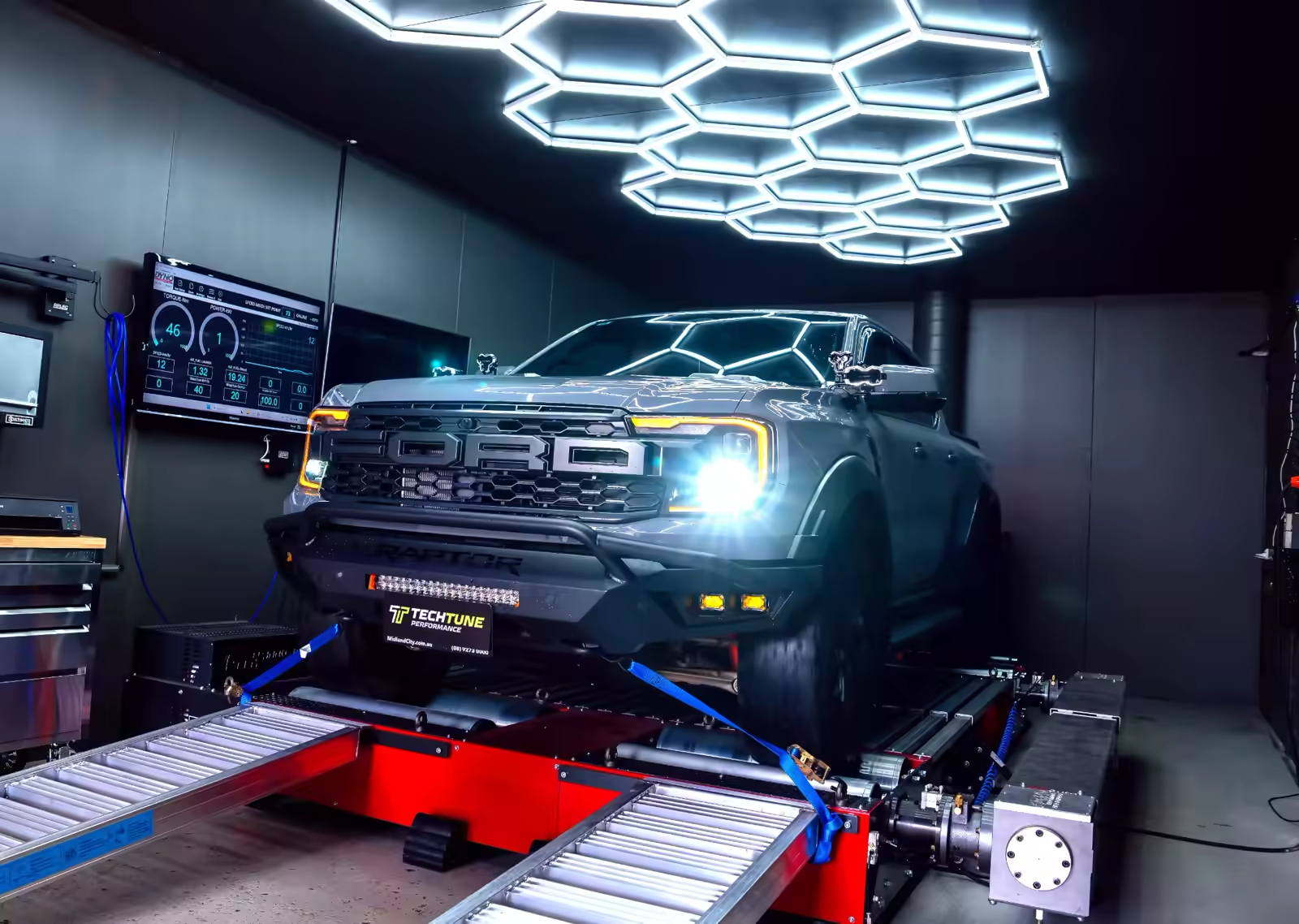
Quick answer: dyno data logging means recording engine and drivetrain data, such as boost, fuel pressure, timing, torque intervention and temperatures, while a vehicle is tested on a dynamometer. The dyno measures power and torque. The logged data shows how the engine and control systems responded. Reviewed together, they show whether a tune behaves as intended under sustained load, which a short drive or a peak power number cannot.
A vehicle can feel stronger after an ECU reflash and still have problems that only appear when the engine works hard. Dyno data logging Perth workshops use for tuning makes those behaviours visible by combining controlled dynamometer testing with relevant vehicle data.
At TechTune Performance in Malaga WA, calibration work is checked with dyno testing and data logging where the vehicle supports it. This guide explains what is logged, what the data can and cannot show, and the questions to ask before you book a tune in Perth.
- Dyno and data do different jobs: the dyno measures power and torque, while ECU, OBD or CAN data explains how the engine got there.
- One number is not enough: boost, fuel pressure, timing and torque intervention need to be read together.
- Available channels vary: not every vehicle exposes every parameter, so a good provider logs what your vehicle actually supports.
- Testing is evidence, not a guarantee: a dyno session cannot promise that no fault will ever develop.
1. What Is Dyno Data Logging?
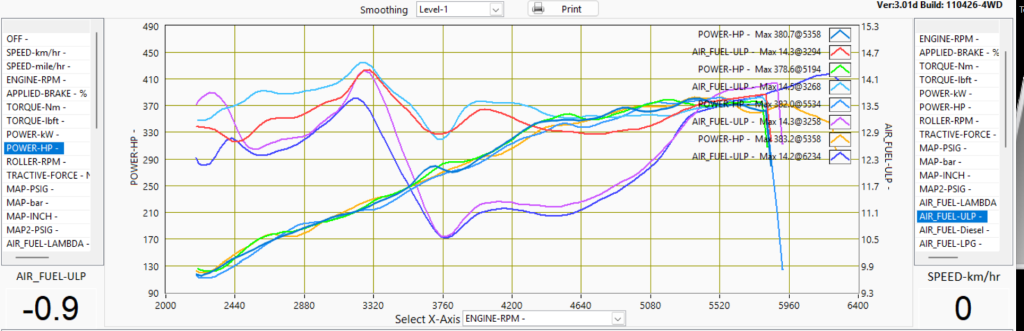
Dyno data logging involves recording selected engine and drivetrain information while a vehicle is tested on a dynamometer. Depending on the vehicle and the systems available, a technician can review boost pressure, fuelling, timing, torque control and transmission behaviour alongside the results of the dyno run.
The dynamometer and the logging system do different jobs. The dyno measures outputs such as power and torque. Diagnostic tools record the electronic control unit’s requested values, actual readings and responses. Reviewing the two together gives a far more useful picture than a peak power figure alone.
For drivers considering dyno data logging Perth providers offer, the important question is not simply how much power a vehicle makes. It is whether the engine and drivetrain behave as expected throughout the test.
2. Why Can a Quick Reflash Miss Important Problems?
An ECU reflash changes software settings that influence how an engine operates. The result depends on the calibration, the vehicle’s condition, its modifications and how the engine management system responds.
A short road drive may reveal obvious problems such as hesitation or warning lights. It may not reproduce what the engine experiences on a long climb, under heavy acceleration or during sustained high load. Some issues only appear when several systems are working together.
That does not mean every reflash is unsafe, and a road test is still useful. It means controlled load testing provides repeatable conditions for comparing data before and after changes, which a start-up check in a carpark or a short drive cannot. Our guide to carpark tuning and dyno testing covers that difference in more detail.
3. Generic Calibration Files vs a Vehicle-Specific Tune
A supplied calibration file can be developed for a particular engine family or configuration. That does not make it unsuitable, but it does not prove it is right for every individual vehicle on that platform either.
Two vehicles with the same badge can have different kilometres, maintenance histories, exhausts, turbochargers or other modifications. A vehicle-specific process takes those details into account: the vehicle is assessed, baseline behaviour is recorded, changes are made where appropriate and the result is checked again. Dyno data logging Perth drivers can review afterwards shows how the vehicle responded under controlled conditions. We explain the difference in custom vs generic tune files.
The method used to create a file does not establish that the finished tune has been validated on your vehicle. What matters is whether the calibration was tested and refined using relevant evidence.
4. Are “Stage 1” and “Stage 2” Reliable Signs of Tune Quality?
Stage labels are widely used, but they have no single technical definition that guarantees a result. One provider’s Stage 1 may not involve the same changes or testing as another’s. The label does not tell you which calibration tables changed, what supporting hardware is needed, whether torque limits were considered or whether the result was tested under load.
Instead of choosing by stage name, ask what work is included, whether the vehicle is checked before tuning, which data is reviewed and whether the final result is retested.
5. What Data Does Dyno Data Logging Perth Testing Review?
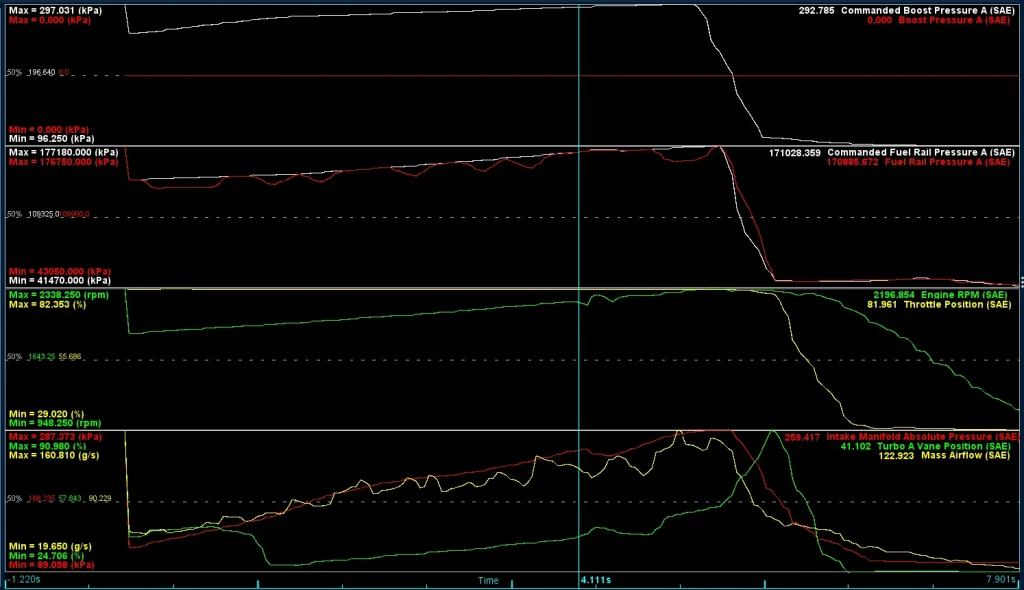
Useful testing combines dynamometer results with ECU or other supported diagnostic data. Not every vehicle exposes the same channels. The available parameters depend on the engine management system, sensors and diagnostic interface.
| Measurement or data channel | What it can help show |
|---|---|
| Dyno power | How measured power changes across the test range. |
| Dyno torque | Where torque rises, falls or changes after calibration adjustments. |
| Engine RPM | The reference point for comparing readings throughout the run. |
| Boost / MAP actual | The pressure the relevant sensor reports during operation. |
| Boost target | The boost level requested by the ECU, where available. |
| Lambda / AFR | Whether the measured air-fuel mixture is consistent with the intended strategy. |
| Fuel rail pressure actual | Whether measured fuel pressure follows expected behaviour under load. |
| Fuel rail pressure target | The pressure requested by the control system, where supported. |
| Ignition or injection timing | How timing changes with engine speed, load and control strategy. |
| Throttle / torque intervention | Whether the ECU is limiting throttle or torque in response to its control logic. |
| Knock-related data | Available knock sensor readings or indicators that may warrant investigation. |
| Temperature data | Intake, coolant, exhaust or other temperatures, if the vehicle exposes them. |
Power and torque are dyno outputs, not ECU logging channels. RPM can come from the dyno, the vehicle or both. The other values generally come from supported ECU, OBD or CAN data, interpreted in the context of the specific vehicle. A strong graph set brings several channels together on a common RPM or time reference, so you can see whether a change in boost, fuel pressure or timing coincides with an unexpected change in torque.
6. How Can Data Logging Reveal a Tuning Issue?
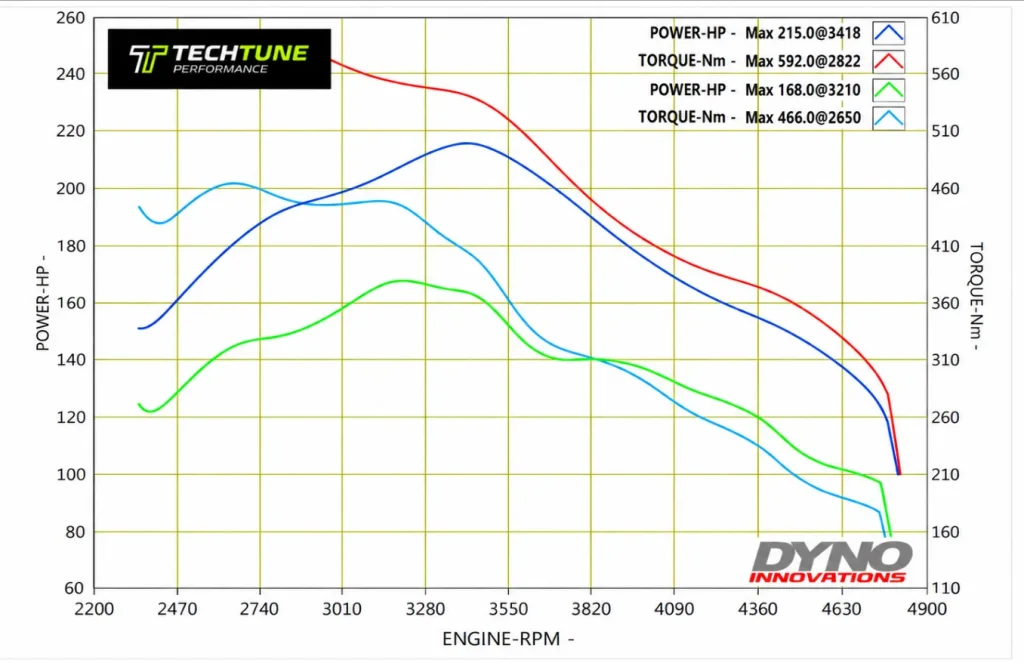
One reading rarely tells the whole story. The value of logging comes from examining how related parameters behave together throughout the test.
- Boost actual vs target: if the two diverge, the cause could be the calibration, a leak, an actuator, a sensor or another mechanical factor. The graph narrows the investigation; it does not name the faulty part on its own.
- Fuel pressure: if actual rail pressure falls away from the requested value under load, the fuel supply, control system, sensor readings or calibration may need attention.
- Timing and knock: ignition timing applies to petrol engines, while injection timing matters for diesel calibration. Knock detection can be essential on applicable petrol engines and may need dedicated monitoring.
- Throttle and torque intervention: the ECU may be limiting output deliberately or in response to a condition that needs diagnosis. The goal is to understand why, not to remove the intervention blindly.
7. Why Do Heat and Transmission Behaviour Matter?
A calibration should not be judged on peak output alone. Heat matters most when an engine works hard for an extended period. Depending on the platform, data may include intake-air, coolant or exhaust gas temperature. Not every vehicle provides every value, and a calculated value should not be treated as a direct sensor reading without checking how it is derived. Responses should be based on evidence and the manufacturer’s limits, not on one universal number.
Transmission behaviour matters too. Automatic gearboxes use torque requests, shift strategies and protective interventions that interact with engine output. Where the vehicle supports it, reviewing engine and transmission data together helps explain shift quality or unexpected torque reduction. For a touring 4WD or a daily-driven performance car, consistent power delivery and dependable operation matter more than the highest peak figure.
8. What Can Go Wrong When a Tune Is Not Properly Checked?
A vehicle that feels sharper after a reflash may still need further assessment. Problems can appear only under particular loads, temperatures or conditions, and a driver may not notice them on a brief trip. Examples include boost control that does not follow its target, inconsistent fuel delivery, unexpected torque intervention, surging or temperature behaviour that needs investigation. Some vehicles enter limp mode if the control system detects a condition outside its permitted range.
These symptoms do not prove the tune is responsible. Existing mechanical faults, worn components, sensor issues or modifications can produce similar signs, so diagnosis should consider the vehicle as a whole, as we outline in our diagnostics service. Testing gives a tuner a better chance of spotting unexpected behaviour in controlled conditions, but it cannot guarantee that every future fault will be prevented.
9. What Should You Ask Before Booking a Tune in Perth?
- Is the calibration developed for my vehicle? Explain any hardware changes, engine condition concerns and how you use the vehicle.
- Will you carry out a baseline test? An initial assessment shows how the vehicle behaves before changes.
- Which channels can you log? The answer should reflect your vehicle’s ECU, sensors and supported data.
- Will the vehicle be retested after changes? Ask how the final calibration is checked and how unexpected readings are investigated.
- How do you assess drivability and transmission behaviour? This matters most for vehicles used for touring or regular heavy-load driving.
Ask what dyno data logging Perth customers actually receive after a session, such as graphs, notes on unexpected readings and an explanation of what changed. A competent provider should also explain the limits of the test. A dyno session is a controlled assessment, not a promise that every fault has been found.
10. WA Compliance, Insurance and Warranty Considerations
Tuning can change how a vehicle is classified for road use, so check the rules before you modify. The WA Government explains the minor, simple and complex modification categories on its vehicle modifications page, and the national VSB 14 National Code of Practice sets out technical requirements for modifying light vehicles. Whether approval or inspection applies depends on the vehicle and the changes involved, so do not assume every ECU change is treated the same way.
Tuning that removes or disables factory emissions equipment is not a legitimate shortcut, and any modification must still meet the applicable emissions and noise requirements. Performance changes may also affect your manufacturer warranty, and insurers generally expect modifications to be disclosed, so speak with your insurer before you proceed.
11. What Does a Proper Testing Process Look Like?
A considered workflow begins before anyone changes the calibration. The vehicle’s condition, modifications and intended use are discussed first, and fault codes or mechanical concerns are dealt with rather than ignored in the hope that a tune will fix them. Baseline testing then sets a reference point. The technician reviews available data, makes appropriate changes and repeats the test under comparable conditions. Comparing like with like matters: if test conditions differ significantly, it becomes harder to know whether a result came from the calibration or from something else.
This is where dyno data logging Perth drivers can understand supports informed decisions. Dyno results show the measured output, and the logged data shows how the engine and control systems responded. If a result is unexpected, the next step is investigation, adjustment where appropriate and another validation run. You can read more about our ECU remapping and TTP tunes, or see supported vehicles. Compatibility and the right test procedure always depend on the individual vehicle.
Conclusion
A tune should be judged by how it performs and how thoroughly it was checked, not by a Stage 1 or Stage 2 label. A quick reflash may change how a vehicle feels, but that alone does not show how boost, fuelling, timing, torque control or transmission behaviour respond under sustained load.
Dyno data logging Perth drivers can review brings together measured dyno results and the vehicle data available for analysis. It helps a tuner assess the calibration, investigate unexpected behaviour and verify changes under repeatable conditions. It is not a promise that every possible fault will be found, but it is a more evidence-based approach than relying on a software file or a short drive. If you are considering a tune, or want to check work already carried out with dyno data logging Perth workshops should be able to explain, contact TechTune Performance to discuss your vehicle, modifications and intended use.
What is dyno data logging used for?
Dyno data logging combines controlled dynamometer testing with available ECU or diagnostic data. It helps technicians assess power and torque alongside engine behaviour, including boost, fuelling, timing and torque control where those channels are supported.
Can a car be tuned without a dyno?
Some calibration work can be done without a dynamometer, and road testing gives useful information. However, a short drive does not offer the same repeatable load conditions as a suitable dyno session. The right method depends on the vehicle, the work being done and the checks required.
Is a generic ECU file the same as a custom tune?
Not necessarily. A supplied file may be designed for a particular platform, but that does not prove the calibration has been checked on your vehicle. A custom process considers the vehicle’s condition, hardware, intended use and test results before validating the finished calibration.
What data should be logged during dyno testing?
Depending on the vehicle, useful channels may include actual and target boost, lambda or AFR, actual and target fuel rail pressure, ignition or injection timing, throttle position and torque intervention. Dyno power and torque are measured by the dyno and reviewed alongside these data.
Do Stage 1 and Stage 2 guarantee a safe tune?
No. Stage labels are not universal standards and do not confirm how a calibration was developed or tested. Ask what changes are included, whether they suit your vehicle and how the result is checked under appropriate operating conditions.
Do I need approval in WA before tuning my vehicle?
It depends on the vehicle and the changes. The WA Government groups modifications into minor, simple and complex categories, and the VSB 14 National Code of Practice sets the technical requirements. Check the current rules for your situation and speak with your insurer before modifying.
Ready For A Properly Tested Tune?
Every calibration is developed around your vehicle using controlled dyno load, live data logging and map-level validation before handover.
