
Quick answer: a 4JJ3 turbo upgrade is worth considering only when the factory turbo is a proven limit for your goals, usually in a higher-output build with supporting upgrades and a matching ECU calibration. For everyday driving and most towing, a well-calibrated factory variable-geometry turbo often delivers better low-RPM response, and a larger turbo can compromise it. In WA, engine and turbo modifications may also need approval, so check the rules first.
You are heading up the Great Northern Highway with a caravan behind your D-MAX. The road starts climbing, you put your foot down and the engine works harder than you would like. Suddenly that bigger turbo you have been thinking about sounds tempting. But will it actually improve your driving?
A 4JJ3 turbo upgrade can unlock more airflow and extra power higher in the rev range. However, bigger does not always mean better. Your factory turbo already does a decent job, and replacing it without a clear plan can mean spending thousands on performance you rarely use. At TechTune Performance in Malaga WA, we start with your engine setup, driving habits and goals, and we use dyno testing and data logging to judge results. This guide shows when an upgrade makes sense and when it does not.
- Define the limit first: prove the factory turbo is the restriction before buying hardware.
- Keep low-RPM response in mind: the factory variable-geometry turbo is good at it, and a larger turbo may not be.
- Plan the whole package: cooling, fuel, intake, exhaust and calibration all need to keep up.
- Check WA rules: engine and turbo changes may need engineering assessment and approval.
1. What Makes the 4JJ3 Engine Worth Upgrading?
The Isuzu 4JJ3-TCX is a 3.0-litre turbo-diesel that powers selected D-MAX, MU-X and Mazda BT-50 models. In standard Australian specification it produces 140 kW and 450 Nm, a solid base for towing, highway driving and weekend trips. Check your model year and compliance details, because specifications can vary between models and updates.
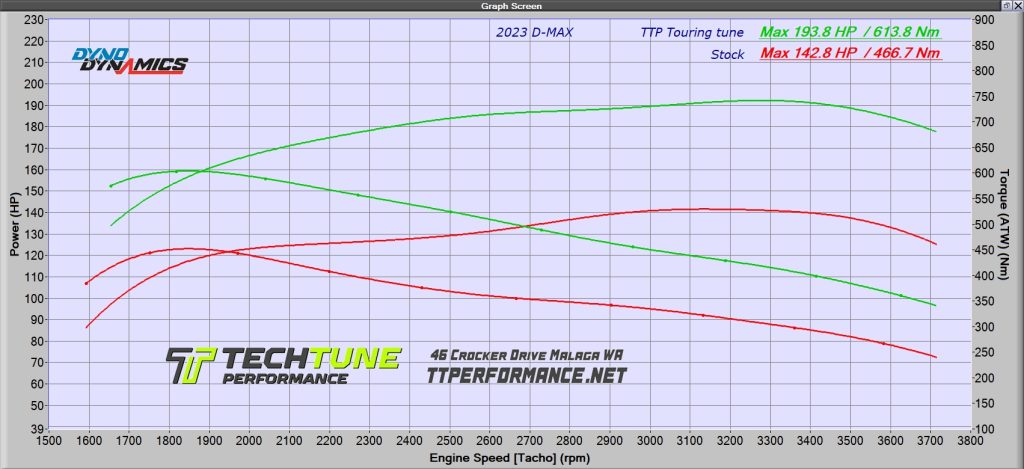
Unlike a basic fixed-geometry turbo, the factory 4JJ3 uses a variable-geometry turbocharger. It adjusts how exhaust gas flows through the turbine to help deliver boost across different engine speeds, so the engine develops useful low-RPM torque without constant high revs. A larger aftermarket turbo can move more air when the engine needs it, but extra airflow alone does not guarantee better performance. Turbo sizing, fuel delivery, ECU calibration and exhaust flow all affect the result, so we judge an upgrade by the entire torque curve, not the highest number on a dyno sheet.
2. When Does a Bigger 4JJ3 Turbo Actually Make Sense?
A bigger turbo makes sense when your current setup approaches its practical airflow limit and you have a specific reason to chase more performance. Perhaps you have already upgraded cooling and calibration but still want stronger acceleration under sustained load or more power higher in the rev range.
If you mainly drive around Perth, commute or tow occasionally, the factory turbo may already suit you. A sensible 4JJ3 turbo upgrade starts by identifying a genuine limitation rather than following the latest modification trend.
3. What Do WA Modification Rules Mean for a Turbo Upgrade?
Check the legal requirements before spending money. The WA Government groups vehicle modifications into minor, simple and complex categories, and complex modifications are assessed through an engineering process. Engine and turbo changes can fall into the more involved categories, so confirm the approval requirements for your exact setup before installation using the WA vehicle modifications page and the VSB 14 National Code of Practice.
Keep all factory emissions equipment in place and working, make sure exhaust changes meet noise and emissions requirements, and tell your insurer about the modification. Warranty cover may also be affected, so ask your dealer or manufacturer before you proceed.
4. Stock Turbo vs Bigger Turbo: What Is the Real Difference?
You do not need the biggest turbo in the catalogue. You need the one that matches your engine and how you drive.
| Feature | Factory 4JJ3 turbo | Larger performance turbo |
|---|---|---|
| Low-RPM response | Strong factory-matched response | Depends on turbo sizing and design |
| Higher-RPM airflow | Limited by factory hardware | Greater potential airflow |
| Daily driving | Well suited to normal use | May require compromises |
| Towing | Good baseline torque delivery | Needs careful matching and calibration |
| Supporting upgrades | Often fewer modifications | May need significant supporting hardware |
| Cost | No replacement expense | Higher parts, labour and tuning costs |
A well-matched turbo can lift performance without making the vehicle frustrating to drive. Go too large, though, and you may lose some of the quick response that makes a diesel 4WD pleasant around town.
5. What Are the Signs Your 4JJ3 Could Benefit From a Turbo Upgrade?
- You want more power than the factory turbo can support. You have already improved intake, intercooler and ECU calibration, yet airflow still limits output at higher engine speeds. We would want proper data logging to confirm the restriction before recommending hardware.
- Your 4WD regularly carries extra weight. Bullbars, roof racks, camping gear and larger tyres change how a vehicle performs, and regional WA touring can add load. Even then, a bigger turbo does not automatically improve low-speed pulling power.
- You are planning a higher-output build. A turbo upgrade can form part of a complete package alongside fuel delivery, intercooling and custom calibration, but plan the whole setup instead of buying one expensive part and hoping the rest keeps up.
- Repeated dyno tests and logs show an airflow limit. If measured data shows the factory turbo cannot meet your target, you have a stronger reason to consider an upgrade. Do not mistake a faulty turbo, boost leak or blocked intake for a need to fit something bigger. Fix the underlying problem first. Our diagnostics service can help find it.

6. What Supporting Upgrades Does a Bigger 4JJ3 Turbo Need?
A turbo does not work alone. Give one part better equipment while the rest struggles to keep up, and you will not get the result you expected.
- Intercooler: a turbo compresses intake air and raises its temperature, and an effective intercooler helps manage that heat, especially on long drives, sustained loads and in Perth summers.
- Air intake and filtration: the engine needs clean air with minimal restriction, which matters on WA’s unsealed roads.
- Fuel system: more airflow only helps if fuel delivery keeps up. Higher-output builds may need injector or other fuel-system changes, and the target output and reliability should be assessed first.
- Exhaust and emissions compliance: exhaust design influences turbine operation, but modifications must meet applicable noise and emissions requirements. Removing or disabling factory emissions equipment is not an acceptable shortcut.
- ECU and transmission calibration: the ECU controls fuel delivery, boost behaviour and torque management, so the calibration must match the new airflow. For automatics, torque management and shift behaviour need attention too. See our ECU remapping page.
7. Is a 4JJ3 Turbo Upgrade Worth It for Towing?
Towing brings many owners to a performance workshop, but it does not automatically justify a larger turbo. When you tow a caravan from Perth towards Geraldton or climb the Perth Hills, you need smooth, consistent torque delivery more than a huge peak figure. For regular towing, we would prioritise:
- Strong torque through the RPM range you actually use.
- Reliable engine and transmission temperature management.
- Smooth throttle response and gear changes.
- Repeatable performance under sustained load.
A carefully calibrated factory turbo can sometimes meet these needs better than an oversized performance turbo. Our recommendation is to start with a vehicle-health check and a baseline dyno assessment, and to consider a larger turbo only when your target genuinely needs more airflow. Always stay within your vehicle’s legal towing and weight ratings.
8. Does the Right Turbo Choice Change Between D-MAX, MU-X and BT-50?
These vehicles can share the 4JJ3 engine, but owners often use them differently. The table below reflects common uses rather than fixed mechanical differences.
| Vehicle | Typical use | Sensible upgrade priority |
|---|---|---|
| Isuzu D-MAX | Work, towing and off-road touring | Usable torque, cooling and drivability |
| Isuzu MU-X | Family travel and caravan towing | Smooth delivery and reliable loaded performance |
| Mazda BT-50 | Daily driving, touring and work | Balanced power and engine response |
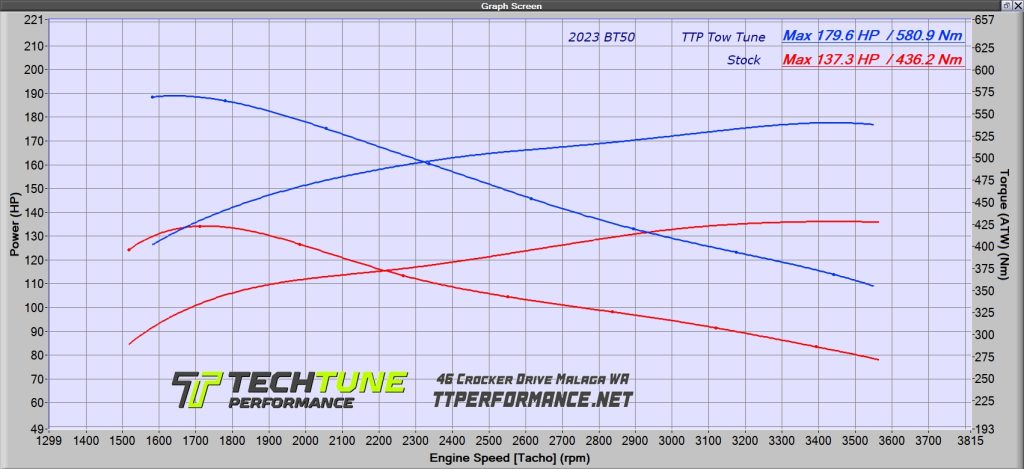
Model year, transmission, condition and existing modifications also affect compatibility. A turbo that suits one high-output D-MAX build may offer little benefit to a lightly modified MU-X. See our vehicle pages for the D-MAX, MU-X and BT-50.
9. How Much Does a 4JJ3 Turbo Upgrade Cost in Perth?
Cost depends on more than the turbo. A complete quote may include the turbo, fitting hardware, installation labour, cooling improvements, fuel-system changes, ECU calibration, compliance work and dyno testing. A straightforward compatible upgrade can cost far less than a major high-output conversion, so rather than quote one universal price we recommend an itemised quote for your actual vehicle. Ask the workshop to separate essential components from optional upgrades, and compare hardware, calibration, compliance, testing and after-sales support instead of peak horsepower alone.
10. Could a Bigger Turbo Reduce 4JJ3 Reliability?
Yes, an unsuitable upgrade can. Higher output places more demand on the engine, cooling system and drivetrain, and poor boost control, excessive exhaust gas temperatures or inappropriate fuelling can cause problems whatever the turbo brand. Before proceeding, have engine condition, boost behaviour, cooling capacity and transmission health checked, and look at performance across the rev range instead of one impressive dyno run. A reliable build delivers repeatable performance without pushing the engine beyond sensible mechanical or thermal limits.
11. When Should You Keep the Factory 4JJ3 Turbo?
Sometimes the smartest upgrade is the one you do not buy. You may not need a larger turbo if:
- You mainly use your vehicle for everyday driving.
- You want better throttle response rather than maximum power.
- Your factory turbo already meets your towing needs.
- You have not yet explored suitable calibration and cooling improvements.
- You want to limit modification costs and possible warranty or insurance complications.
12. How Do You Choose the Right 4JJ3 Turbo Setup in Perth?
Before booking anything, ask the workshop these five questions:
- What specific limitation does the factory turbo have?
- How will the new turbo affect low-RPM torque and response?
- Which supporting modifications does my vehicle genuinely need?
- Can you demonstrate results through dyno testing and data logging?
- What approval, emissions, warranty and insurance considerations apply?
Clear answers matter more than impressive advertising, and a suitable workshop should explain expected benefits, trade-offs and total cost without making unrealistic promises.
Conclusion
A 4JJ3 turbo upgrade can make a real difference in a higher-output D-MAX, MU-X or BT-50 build, but it is rarely the best first modification. If you want stronger everyday response or better towing performance, start by understanding what your current turbo and calibration can already do. If your goals demand more airflow and sustained higher output, a properly matched turbo with suitable supporting hardware, approvals and calibration may justify the investment.
Ready to work out the right setup for your 4JJ3? Contact TechTune Performance in Malaga to discuss your driving needs, current modifications and goals, and get advice on ECU calibration, dyno testing and data logging for your vehicle.
How much power can a 4JJ3 turbo upgrade add?
It depends on the turbo design, fuel delivery, cooling and ECU calibration. A larger turbo creates the potential for higher output, but it does not guarantee a particular gain. Ask for realistic targets and dyno data from comparable builds, and treat any promised figure with caution.
Can I upgrade my 4JJ3 turbo without an ECU remap?
You should not assume the factory calibration will suit a different turbo. Changes to airflow and boost behaviour can require calibration adjustments, so a professional tuner should assess the hardware, ECU strategy and vehicle condition before you drive with the new setup.
Will a bigger turbo improve fuel economy on my D-MAX or MU-X?
Not necessarily. Turbo sizing and calibration can influence efficiency, but driving habits, vehicle weight, towing loads and power demands also affect fuel use. If economy is your main goal, assess your engine condition and tuning options before investing in a larger turbo.
Is a bigger turbo better than the factory 4JJ3 turbo for towing?
Not always. The factory variable-geometry turbo gives useful low-RPM response, which matters when towing. A larger turbo may support more power, but the wrong setup can compromise response at lower engine speeds. Choose a combination that suits your load, conditions and reliability priorities.
Do I need approval in WA for a turbo upgrade?
Possibly. The WA Government groups modifications into minor, simple and complex categories, and engine changes can need engineering assessment. Check the WA vehicle modifications guidance and VSB 14 for your exact setup before installation, keep emissions equipment compliant and tell your insurer.
What engines does the 4JJ3 turbo-diesel power?
The Isuzu 4JJ3-TCX 3.0-litre turbo-diesel powers selected Isuzu D-MAX and MU-X models and the Mazda BT-50. In standard Australian specification it makes 140 kW and 450 Nm. Check your model year, because specifications can vary.
Ready For A Properly Tested Tune?
Every calibration is developed around your vehicle using controlled dyno load, live data logging and map-level validation before handover.
